Book 4. (1 results) Nomads of Gor (Individual Quote)
| Chapter # | Sentence # | Quote |
|---|---|---|
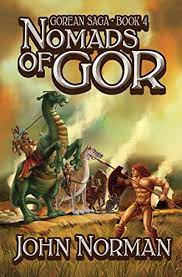
| 2 | 67 | His View more quotes about lance">lance remained on his back, but he carried in his right hand the small, powerful horn bow of the Wagon Peoples and attached to his saddle was a lacquered, narrow, rectangular quiver containing as many as forty arrows. |
 |
Book 4. (7 results) Nomads of Gor (Context Quote)
| Chapter # | Sentence # | Quote |
|---|---|---|
| 2 | 64 | I could not see his face because of the net of chain that hung before it. |
| 2 | 65 | I also noted, about his throat, now lowered, there was a soft leather wind scarf which might, when the helmet veil was lifted, be drawn over the mouth and nose, against the wind and dust of his ride. |
| 2 | 66 | He was very erect in the saddle. |
| 2 | 67 | His lance remained on his back, but he carried in his right hand the small, powerful horn bow of the Wagon Peoples and attached to his saddle was a lacquered, narrow, rectangular quiver containing as many as forty arrows. |
| 2 | 68 | On the saddle there also hung, on one side, a coiled rope of braided boskhide and, on the other, a long, three-weighted bola of the sort used in hunting tumits and men; in the saddle itself, on the right side, indicating the rider must be right-handed, were the seven sheaths for the almost legendary quivas, the balanced saddleknives of the prairie. |
| 2 | 69 | It was said a youth of the Wagon Peoples was taught the bow, the quiva and the lance before their parents would consent to give him a name, for names are precious among the Wagon Peoples, as among Goreans in general, and they are not to be wasted on someone who is likely to die, one who cannot well handle the weapons of the hunt and war. |
| 2 | 70 | Until the youth has mastered the bow, the quiva and the lance he is simply known as the first, or the second, and so on, son of such and such a father. |
|
I could not see his face because of the net of chain that hung before it.
I also noted, about his throat, now lowered, there was a soft leather wind scarf which might, when the helmet veil was lifted, be drawn over the mouth and nose, against the wind and dust of his ride.
He was very erect in the saddle.
His lance remained on his back, but he carried in his right hand the small, powerful horn bow of the Wagon Peoples and attached to his saddle was a lacquered, narrow, rectangular quiver containing as many as forty arrows.
On the saddle there also hung, on one side, a coiled rope of braided boskhide and, on the other, a long, three-weighted bola of the sort used in hunting tumits and men; in the saddle itself, on the right side, indicating the rider must be right-handed, were the seven sheaths for the almost legendary quivas, the balanced saddleknives of the prairie.
It was said a youth of the Wagon Peoples was taught the bow, the quiva and the lance before their parents would consent to give him a name, for names are precious among the Wagon Peoples, as among Goreans in general, and they are not to be wasted on someone who is likely to die, one who cannot well handle the weapons of the hunt and war.
Until the youth has mastered the bow, the quiva and the lance he is simply known as the first, or the second, and so on, son of such and such a father.
- (Nomads of Gor)