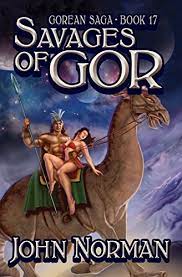
Book 17. (1 results) Savages of Gor (Individual Quote)
| Chapter # | Sentence # | Quote |
|---|---|---|
| 1 | 1018 | Too, they are View more quotes about often">often undecorated, save perhaps for a knot of the feathers of the yellow, long-winged, sharp-billed prairie fleer, or, as it is sometimes called, the maize bird, or corn bird, considered by the red savages to be generally the first bird to find food. |
 |
Book 17. (7 results) Savages of Gor (Context Quote)
| Chapter # | Sentence # | Quote |
|---|---|---|
| 1 | 1015 | It is to be distinguished in particular from the longer, heavier tharlarion lance, designed for use from tharlarionback, and often used with a lance rest, and the smaller, thicker stabbing lances used by certain groups of pedestrian nomads. |
| 1 | 1016 | The kaiila lance takes, on the whole, two forms, the hunting lance and the war lance. |
| 1 | 1017 | Hunting lances are commonly longer, heavier and thicker than war lances. |
| 1 | 1018 | Too, they are often undecorated, save perhaps for a knot of the feathers of the yellow, long-winged, sharp-billed prairie fleer, or, as it is sometimes called, the maize bird, or corn bird, considered by the red savages to be generally the first bird to find food. |
| 1 | 1019 | The point of the hunting lance is usually longer and narrower than that of the war lance, a function of the depth into which one must strike in order to find the heart of the kailiauk. |
| 1 | 1020 | The shafts of the kaiila lances are black, supple and strong; they are made of tem wood, a wood much favored on Gor for this type of purpose. |
| 1 | 1021 | Staves for the lances are cut in the late winter, when the sap is down. |
|
It is to be distinguished in particular from the longer, heavier tharlarion lance, designed for use from tharlarionback, and often used with a lance rest, and the smaller, thicker stabbing lances used by certain groups of pedestrian nomads.
The kaiila lance takes, on the whole, two forms, the hunting lance and the war lance.
Hunting lances are commonly longer, heavier and thicker than war lances.
Too, they are often undecorated, save perhaps for a knot of the feathers of the yellow, long-winged, sharp-billed prairie fleer, or, as it is sometimes called, the maize bird, or corn bird, considered by the red savages to be generally the first bird to find food.
The point of the hunting lance is usually longer and narrower than that of the war lance, a function of the depth into which one must strike in order to find the heart of the kailiauk.
The shafts of the kaiila lances are black, supple and strong; they are made of tem wood, a wood much favored on Gor for this type of purpose.
Staves for the lances are cut in the late winter, when the sap is down.
- (Savages of Gor)