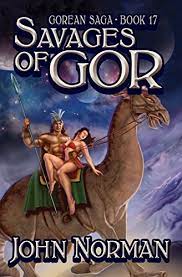
Book 17. (1 results) Savages of Gor (Individual Quote)
| Chapter # | Sentence # | Quote |
|---|---|---|
| 1 | 1128 | He would View more quotes about rather">rather rescue one comrade than slay ten of the enemy. |
 |
Book 17. (7 results) Savages of Gor (Context Quote)
| Chapter # | Sentence # | Quote |
|---|---|---|
| 1 | 1125 | Accordingly, one's fellows are seldom close at hand to rescue one. |
| 1 | 1126 | This is quite different from mounted warfare, where one's fellows are usually quite close and ready, in an instant, to sweep one up or help one to regain one's mount. |
| 1 | 1127 | The red savage does not take an industrial or arithmetical approach to warfare. |
| 1 | 1128 | He would rather rescue one comrade than slay ten of the enemy. |
| 1 | 1129 | This has to do with the fact that they are members of the same tribe and, usually, of the same warrior society. |
| 1 | 1130 | They will have known one another almost all of their lives; as children and boys they have played together and watched the kaiila herds in the summer camps together; they may even have shared in their first kailiauk hunt; now, as men, they have taken the warpath together; they are comrades, and friends; each is more precious to the other than even a thousand coups. |
| 1 | 1131 | This explains some of the eccentricities of tribal warfare; first, actual war parties, though common, are formed less often than parties for stealing kaiila; in this sport the object is to obtain as many kaiila as possible without, if possible, engaging the enemy at all; it is a splendid coup, for example, to cut a kaiila tether strap which is tied to the wrist of a sleeping enemy and make off with the animal before he awakens; killing a sleeping enemy is only a minor coup; besides, if he has been killed, how can he understand how cleverly he has been bested; imagine his anger and chagrin when he awakens; is that not more precious to the thief than his scalp; in actual warfare itself large-scale conflicts almost never occur. |
|
Accordingly, one's fellows are seldom close at hand to rescue one.
This is quite different from mounted warfare, where one's fellows are usually quite close and ready, in an instant, to sweep one up or help one to regain one's mount.
The red savage does not take an industrial or arithmetical approach to warfare.
He would rather rescue one comrade than slay ten of the enemy.
This has to do with the fact that they are members of the same tribe and, usually, of the same warrior society.
They will have known one another almost all of their lives; as children and boys they have played together and watched the kaiila herds in the summer camps together; they may even have shared in their first kailiauk hunt; now, as men, they have taken the warpath together; they are comrades, and friends; each is more precious to the other than even a thousand coups.
This explains some of the eccentricities of tribal warfare; first, actual war parties, though common, are formed less often than parties for stealing kaiila; in this sport the object is to obtain as many kaiila as possible without, if possible, engaging the enemy at all; it is a splendid coup, for example, to cut a kaiila tether strap which is tied to the wrist of a sleeping enemy and make off with the animal before he awakens; killing a sleeping enemy is only a minor coup; besides, if he has been killed, how can he understand how cleverly he has been bested; imagine his anger and chagrin when he awakens; is that not more precious to the thief than his scalp; in actual warfare itself large-scale conflicts almost never occur.
- (Savages of Gor)