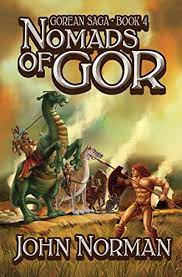
Book 4. (1 results) Nomads of Gor (Individual Quote)
| Chapter # | Sentence # | Quote |
|---|---|---|
| 14 | 5 | Each man View more quotes about knows">knows his position in his Ten, and the position of his Ten in the Hundred, and of the Hundred in the Thousand. |
 |
Book 4. (7 results) Nomads of Gor (Context Quote)
| Chapter # | Sentence # | Quote |
|---|---|---|
| 14 | 2 | War lanterns, green and blue and yellow, were already burning on poles in the darkness, signaling the rallying grounds of the Orlus, the Hundreds, and the Oralus, the Thousands. |
| 14 | 3 | Each warrior of the Wagon Peoples, and that means each able-bodied man, is a member of an Or, or a Ten; each ten is a member of an Orlu, or Hundred; each Orlu is a member of an Oralu, a Thousand. |
| 14 | 4 | Those who are unfamiliar with the Wagon Peoples, or who know them only from the swift raid, sometimes think them devoid of organization, sometimes conceive of them as mad hordes or aggregates of wild warriors, but such is not the case. |
| 14 | 5 | Each man knows his position in his Ten, and the position of his Ten in the Hundred, and of the Hundred in the Thousand. |
| 14 | 6 | During the day the rapid movements of these individually maneuverable units are dictated by bosk horn and movements of the standards; at night by the bosk horns and the war lanterns slung on high poles carried by riders. |
| 14 | 7 | Kamchak and I mounted the kaiila we had ridden and, as rapidly as we could, pressed through the throngs toward our wagon. |
| 14 | 8 | When the bosk horns sound the women cover the fires and prepare the men's weapons, bringing forth arrows and bows, and lances. |
|
War lanterns, green and blue and yellow, were already burning on poles in the darkness, signaling the rallying grounds of the Orlus, the Hundreds, and the Oralus, the Thousands.
Each warrior of the Wagon Peoples, and that means each able-bodied man, is a member of an Or, or a Ten; each ten is a member of an Orlu, or Hundred; each Orlu is a member of an Oralu, a Thousand.
Those who are unfamiliar with the Wagon Peoples, or who know them only from the swift raid, sometimes think them devoid of organization, sometimes conceive of them as mad hordes or aggregates of wild warriors, but such is not the case.
Each man knows his position in his Ten, and the position of his Ten in the Hundred, and of the Hundred in the Thousand.
During the day the rapid movements of these individually maneuverable units are dictated by bosk horn and movements of the standards; at night by the bosk horns and the war lanterns slung on high poles carried by riders.
Kamchak and I mounted the kaiila we had ridden and, as rapidly as we could, pressed through the throngs toward our wagon.
When the bosk horns sound the women cover the fires and prepare the men's weapons, bringing forth arrows and bows, and lances.
- (Nomads of Gor)