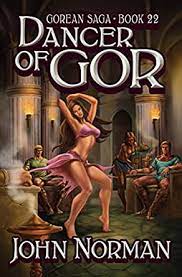
Book 22. (1 results) Dancer of Gor (Individual Quote)
| Chapter # | Sentence # | Quote |
|---|---|---|
| 6 | 322 | View more quotes about perhaps">Perhaps she hated men and it was thus an insidious, half-understood way of attacking them, by attempting to spoil and ruin us, by trying to make us inert and like herself. |
 |
Book 22. (7 results) Dancer of Gor (Context Quote)
| Chapter # | Sentence # | Quote |
|---|---|---|
| 6 | 319 | I was proud to belong to men, to men such as those of this world! I would thus, rightfully, and joyously, kneel before them as what I was, a woman, and their slave. |
| 6 | 320 | What was the problem of women such as she who had beaten on the wagon? Did she wish, in her heart, I wondered, that she, too, could kneel thusly, owned? Then I dismissed that thought as foolish, doubtlessly foolish. |
| 6 | 321 | Not such a woman! Never such a woman! But then why was she so hostile? Did she think that our service and beauty, our yielding to our hearts, lessened or demeaned her in some way? What a puzzling inference! What an absurd conclusion! What a grotesque mockery of thought that would be! Must all women be alike? Could there be legitimately only a single type of female, and that the grotesque projection of her own feminine insufficiencies, her misery and hatred? If anything, it seemed that our abjectness might have made her own status, presumably different from ours, seem even finer and more exalted. |
| 6 | 322 | Perhaps she hated men and it was thus an insidious, half-understood way of attacking them, by attempting to spoil and ruin us, by trying to make us inert and like herself. |
| 6 | 323 | The issues seemed complex. |
| 6 | 324 | At any rate there seemed no objective justification for her trying to make us like her. |
| 6 | 325 | What was so marvelous or desirable, really, about her unhappiness and hardness, her cruelty and frustration, that we, lesser women, should find it preferable to love? Why did she so hate us? Did our nature, and softness, contradict her views, showing them false? Perhaps that was it, that she in some strange, almost incomprehensible way felt refuted by us, and our feelings, or threatened by us. |
|
I was proud to belong to men, to men such as those of this world! I would thus, rightfully, and joyously, kneel before them as what I was, a woman, and their slave.
What was the problem of women such as she who had beaten on the wagon? Did she wish, in her heart, I wondered, that she, too, could kneel thusly, owned? Then I dismissed that thought as foolish, doubtlessly foolish.
Not such a woman! Never such a woman! But then why was she so hostile? Did she think that our service and beauty, our yielding to our hearts, lessened or demeaned her in some way? What a puzzling inference! What an absurd conclusion! What a grotesque mockery of thought that would be! Must all women be alike? Could there be legitimately only a single type of female, and that the grotesque projection of her own feminine insufficiencies, her misery and hatred? If anything, it seemed that our abjectness might have made her own status, presumably different from ours, seem even finer and more exalted.
Perhaps she hated men and it was thus an insidious, half-understood way of attacking them, by attempting to spoil and ruin us, by trying to make us inert and like herself.
The issues seemed complex.
At any rate there seemed no objective justification for her trying to make us like her.
What was so marvelous or desirable, really, about her unhappiness and hardness, her cruelty and frustration, that we, lesser women, should find it preferable to love? Why did she so hate us? Did our nature, and softness, contradict her views, showing them false? Perhaps that was it, that she in some strange, almost incomprehensible way felt refuted by us, and our feelings, or threatened by us.
- (Dancer of Gor)