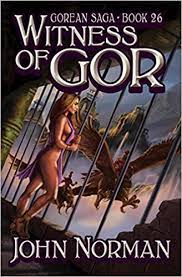
Book 26. (1 results) Witness of Gor (Individual Quote)
| Chapter # | Sentence # | Quote |
|---|---|---|
| 12 | 710 | One may also be "View more quotes about bound">bound by the master's will," in which case one must keep one's limbs in a given position, perhaps wrists crossed, at the back of one's head, as though they were literally bound, forbidden to separate them without permission. |
 |
Book 26. (7 results) Witness of Gor (Context Quote)
| Chapter # | Sentence # | Quote |
|---|---|---|
| 12 | 707 | To be sure, they are not stupid, no more than other women, and can be taught them quickly. |
| 12 | 708 | Most slaves, after all, doubtless, were once free women. |
| 12 | 709 | One interesting form of gag is being "gagged by the master's will," in which the woman is simply forbidden to speak, except, of course, for whimpers, in response to direct questions. |
| 12 | 710 | One may also be "bound by the master's will," in which case one must keep one's limbs in a given position, perhaps wrists crossed, at the back of one's head, as though they were literally bound, forbidden to separate them without permission. |
| 12 | 711 | I do not know why one whimper is used for "Yes," and two for "No". |
| 12 | 712 | It is probably because one usually thinks of such responses, for whatever reason, in terms of "Yes" and "No," rather than of "No" and "Yes". |
| 12 | 713 | It does not seem to be correlated with the greater frequency of affirmative to negative responses to questions. |
|
To be sure, they are not stupid, no more than other women, and can be taught them quickly.
Most slaves, after all, doubtless, were once free women.
One interesting form of gag is being "gagged by the master's will," in which the woman is simply forbidden to speak, except, of course, for whimpers, in response to direct questions.
One may also be "bound by the master's will," in which case one must keep one's limbs in a given position, perhaps wrists crossed, at the back of one's head, as though they were literally bound, forbidden to separate them without permission.
I do not know why one whimper is used for "Yes," and two for "No".
It is probably because one usually thinks of such responses, for whatever reason, in terms of "Yes" and "No," rather than of "No" and "Yes".
It does not seem to be correlated with the greater frequency of affirmative to negative responses to questions.
- (Witness of Gor)